Pilgrimage III

So many tiny details of my childhood continue to come to mind after our recent trip “back home.”  Every time I relate a story to someone or send a picture on to a family member, more and more tiny bits fall into place.

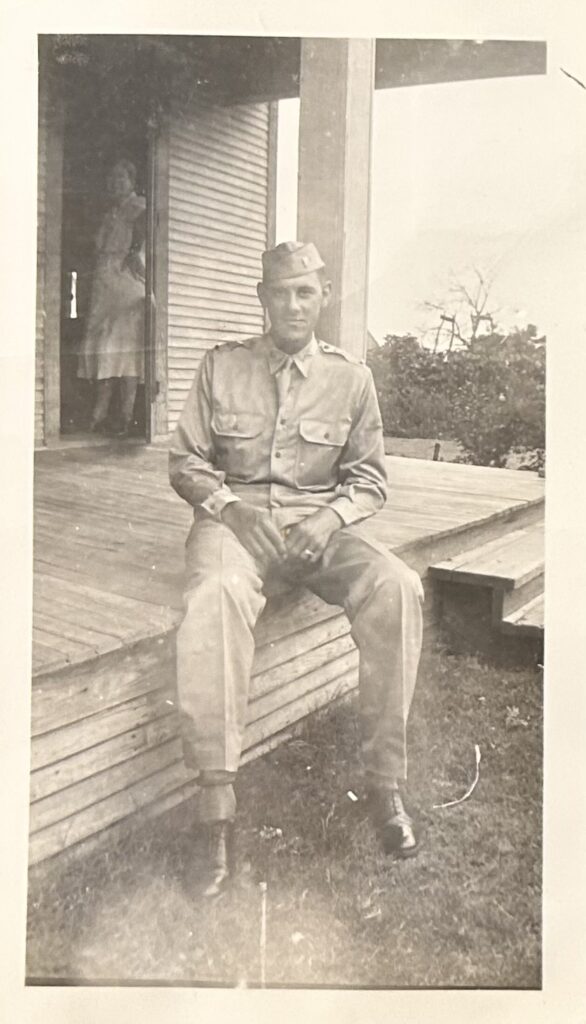
Last week, I sent some very old photos to my cousin Chuck.  One of his father, Uncle George, sitting on my maternal great-grandparents’ front porch in a tiny town 12 miles north of Durant — Kenefic.  They raised their nine children there.
Chuck asked whether we unearthed any more pictures of that house when Joannie and I poured through the two big tubs of documents. I responded with this:

“You know, the only picture we found of the house in Kenefic was the one I sent you of Uncle George sitting on the front steps — his mother, your grandmother, my great-grandmother standing in the doorway.   I have so many memories of that house — the porch swing, the primitive kitchen where Ma-Ma prepared wonderful meals, the outhouse, the storm cellar. All gone now. Joannie and I drove around the ruins of Kenefic for an hour trying to find anything I could remember. I couldn’t even find the railroad tracks! How could railroad tracks disappear? There was a “new” Methodist Church building where the old one used to be. ( I don’t remember this, but Mother said Ma-Ma used to play the pump organ there.) And the poverty! We saw people living in falling-down houses with junked appliances and vehicles in the yard. Heart-breaking. Our ancestors lived very modestly there, but they were very hard-working and maintained their homes well.”

This is exactly the way I remember them.  They seemed — and looked  — quite old to me, but you can see from their gravestone, Pa-Pa was only 71 when he died, and Ma-Ma was  80.  I was present at both their funerals and was able to walk right to their graves to take this picture last month.
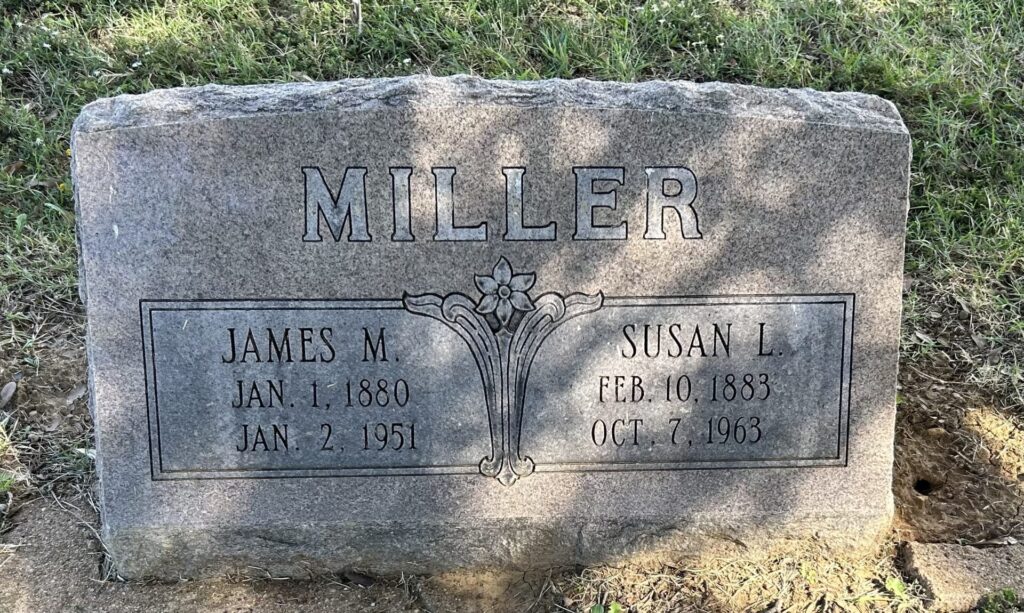
They had lovely names —  James Monroe and Susan Louise — and gave all their children lovely names too:  Maud Kate, James Monroe, William, Stephen, Samford, (Ma-Ma’s maiden name), Mary, Caroline, George, and Frances. I remember them all very well.

Part II

Most of what we discovered on our search through SE Oklahoma was accurate and heart-warming.  But some things were hard.  The fact that most of the houses I lived in, from Durant to Ringling to Healdton had been torn down or replaced was hard. The one in Healdton was truly a pile of rubble.  I have so many happy memories there from ages 6 to 9.  The original Methodist Church survives. Everything looked so much smaller than I remembered it.

The house in Ringling, where I went to school from 4th through 9th grades, was in disrepair. We were able to find the shambles of the big  brick and stone BBQ pit that Daddy had built in the back yard. Trees had grown up through it  We were able to retrieve a piece of the beautiful stone we had collected from the Arbuckle mountains and, with the present resident’s permission, Joannie took it home. The Methodist Church I faithfully attended has been replaced by a lovely brick one. My school had been torn down, but the old gym that had been built  by the WPA  still stood.

Back in Durant, I had mixed feelings about the statue of the young Confederate rifleman, still standing in front of the Bryan County Courthouse where it was placed by the Daughters of the Confederacy in 1920.  I suppose it represents a part of history.  Bryan County was commonly referred to as “Little Dixie.”  Notice that beautiful magnolia.

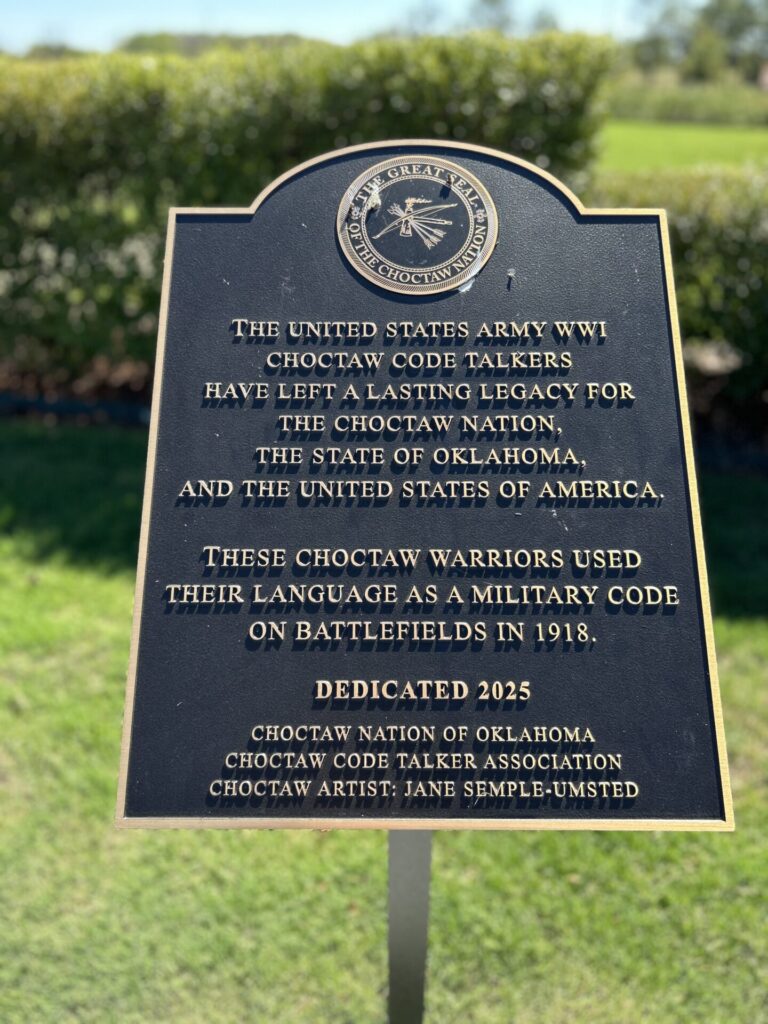
On another subject,  I am always a bit disappointed that the Navajos get all the credit for being the first code talkers during WWII.  Choctaw boys from Oklahoma were the first ones, deployed to Europe during WWI .

When given an opportunity, I always try to correct this misconception.

We did collect some more accurate history at the cultural center, some of it positive.

Some, heart breaking.

Oklahoma Pilgrimage, October 2026, Part I

This trip, which had been carefully planned and aborted several times before because of winter storms, a pandemic, and housesitting issues, ultimately came together in October, 2026. It was truly amazing in ways I had not anticipated.

One of the amazing amazing things was how I was able to get to DFW on time, and Joannie was able to find me out front of some terminal or another ( terminals and baggage claim areas kept “updating” along the way.)  I, in my pre-booked wheelchair, was transported like royalty in a sedan chair from place to place.

And, once in Joannie’s luxurious pickup truck, we headed north to the house she had rented for us in Durant, Oklahoma, the town where I and my parents were born.

Of course, we had to make a stop at a Texas landmark on the way.

We kept our strength up with a BBQ brisket sandwich and fudge. We have a history of buying fudge on road trips.

Soon, at the end of a very long day. (Joannie had driven 500 miles across Texas.) We found the beautiful, comfortable house Joannie had rented for us, built in 1943

It was about half-a mile from the house my grandparents had lived in and half-a mile from the hospital I had been born in, also in 1943  It is all boarded up now.

The next day, we planned to take it easy and tour Durant.  Joan did not grow up in Oklahoma as our family moved to Texas when I was 15 and she was 2.  I had so many memories of that small town to share with her.   We tried to find all the rental houses my maternal grandparents had lived in. Some house numbers we found on old photos.

We knew exactly where the Capshaw’s big rock house stood.  Gone now.  A gigantic water tower stands there now. I snapped these shots years ago.

My grandfather, some of his friends and sons, gathered the red sandstone in the area and hauled it in a wagon.  Granddaddy had no use for finery, but you can see the stone detail around the door is quite lovely.

And Grandmother had a lovely rose garden that was on the left in this shot of the driveway.

We also visited the Choctaw Cultural Center that day where we had an unexpectedly  blow-away experience.  Our family historian and anthropologist, Mary-Margaret, had been in communication with Dr, Ian Thompson, Choctaw archologist, anthropologist, and linguist, and arranged with him to authenticate our paternal grandfather’s (Papa Harrison’s) childhood hunting bow, which Joannie unearthed many hears ago in a garage behind Mama Harrison’s house at 902 West Cedar.  Joannie followed up to arrange a meeting.

I was expecting maybe five minutes during which Thompson would stand up from behind his desk, take a look, and say, “nice bow.”  But no!  That scholar, who insists only being called “Ian,” had reserved a room and assembled his staff to carefully examine and document the bow at length.  I was deeply moved by this.

He handled it like it was a precious, tribal artifact.  Indeed, it is. A boy’s small-animal hunting bow from c. 1990, made of native bois d’arc.  And, in fact, when leaving, we spotted a bois d’arc growing nearby.

These letters were scratched on the bow.  Even the tribal linguists could not figure out what a boy was trying to write here:

Bone Spurs and All

I really enjoy conversations with my new best friend ChatGPT where I was recently very simply directed to some detailed information I needed about my loaner from the Subaru dealership. (There’s no longer a users’ book in the glove box, and I needed to pop open the fuel door.) However, some people are really scared about AI, and I can understand that. Just look what can be created with almost no skill at all.

My Home Town

About once a month, I drive over the river to the other part of town where I lived for thirty years. It’s really the same town, but it seems like another one to me. And like a different life.  I lived in the same house there for 26 years which is the longest I ever lived in a house.

When I was little, we moved all over southern Oklahoma every few years as Daddy”s work moved.  He worked for a petroleum company that was laying pipelines all across there.  The longest I ever lived anyplace then was in a little town called Ringling.  It had about 1200 people in it. Fourth grade through ninth.

I was pretty much an only child, so I planned to raise a large family in one house forever.  Funny how things work out.

Anyway, across the bridge where I used to live, I still know where to find everything.  I know where to buy an expensive loaf of white bread once a year to eat tomato sandwiches for a week.  I know where to go to a softball field behind Trader Joe’s once a year to pick up sweet Italian plus off the ground.  I did those two things today.  And I know every tree I planted at 1880 and drive through the alley there and talk to them,  Those redwoods remember me and they will be there long after I have stopped driving by.